


Fungus is an infectious disease and most often affects the nails or the skin of the feet.You can get infected very easily;danger lurks almost everywhere.Since the fungus is essentially an infection, it lives mostly in public places.To eliminate the possibility of infection, it is important to know how the pathology is transmitted to people.
How does the infection occur?

The disease always starts because of a wet environment.The main reason will be constant sweating of the feet.Statistics show that a high concentration of parasites is observed in public places, such as saunas, baths, swimming pools, etc.It is impossible to destroy the pathogen by drying shoes or feet.
When we ask how contagious the fungus is, it can be argued that the pathology is quite easily transmitted from person to person.It is almost impossible to insure yourself against such diseases.Many pathogens are found in public places where people walk barefoot.This means that if a healthy person steps barefoot on the surface where an infected person previously stood, with the presence of provoking factors, the disease will immediately begin to progress.
The fungus is very resistant to various destructive factors, so it stays on surfaces for a long time.On the beaches, the fungus is much less common, because the salt water destroys the pathogen, however, the risk of infection still remains.Remember to always wear only your slippers, socks and shoes.
The first signs of nail fungus and their symptoms
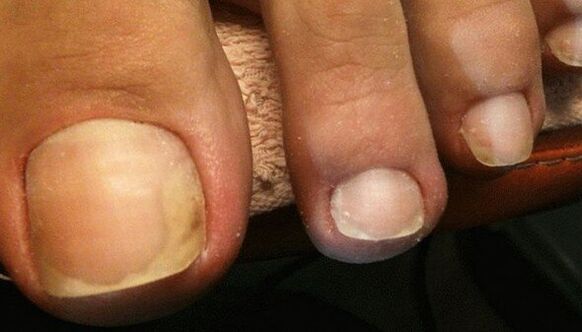
Foot mycosis is always in the development phase, so the first signs of nail fungus can be noticed in the early stages if you carefully monitor the condition of your body.The different stages of the fungus differ in their characteristics.If the first stages of the disease can still be missed due to inattention to oneself, then the latter will be clearly felt.Let's look at the symptoms that appear in the early stages:
- small dots appear on a healthy nail, which differ in their shade from the rest of the plate;
- over time, such dots begin to grow and turn into white spots and stripes;
- later the spots become large, and the nail plate loses its shine;
- the plate takes on a yellow hue, sometimes changing to blue or green.
How to determine pathology at home
If the nail changes color and becomes loose, it does not necessarily mean that it is affected by the fungus.How does toenail fungus occur?Iodine and potassium permanganate are used to determine fungal infection at home.
- Potassium permanganate.This procedure is quite simple and does not require a lot of free time.Pour warm water into a container and add potassium permanganate to make the solution weak.Place your feet in the sink and wait 10 minutes.During this time, healthy nail plates will turn brown, while those affected by the fungus will remain unchanged.
- Iodine.Unfortunately, this medication does not detect that there is a fungal pathogen on the feet.But iodine will indicate the exclusion of other types of fungi, including pityriasis versicolor.If redness, peeling, etc. is visible around the nail, treat this area with iodine.Healthy tissue will not darken much, but affected tissue will take on a fairly dark shade.
Treatment
Treatment of foot fungus begins with diagnosis.First, the dermatologist conducts a visual examination, and then prescribes laboratory tests.Do not forget that in no case should you stop the treatment after the first improvements, because fungi are very resistant, so the disease develops again.
Local therapy
Creams, ointments, lotions, sprays and medicated varnishes are used as local preparations.Such drugs relieve symptoms well and destroy surface lesions.The products are actively used in childhood and pregnancy, because they are absolutely safe.Local therapy is especially effective in the early stages of the pathology.
Medicines

Taking medication increases the effectiveness of local fungal treatment.The tablets penetrate the blood and kill the fungus in the body.But this method has a number of significant drawbacks.Firstly, drugs have a number of contraindications, and secondly, they have side effects.It is not possible to take such medicines in all cases.However, medication is the only solution that will help in advanced cases.In order to increase the effectiveness of treatment, local drugs, medicines and traditional medicine are used at the same time.
Laser treatment
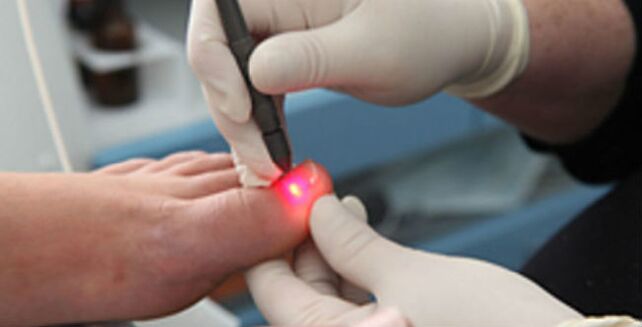
The procedure of laser therapy is becoming more and more popular.The technique was recently implemented, and its effectiveness has already been proven.Laser therapy has the following advantages:
- The treatment is safe;the beam only treats the affected tissue.After the event, only healthy tissue remains.
- The procedure is painless and patients tolerate it well.
- The improvement is already visible after the first session.
- About 4 procedures are enough to achieve a positive result.
The use of laser frees the patient from taking harmful drugs and long treatment.
Operation
In some cases, complete removal of the affected nail is necessary.The operation is performed to completely stop the further spread of the infection.This procedure can increase the effectiveness of the use of topical medications.Nail removal can be done using special compounds.It is important for the specialist to be careful.So that such a substance does not get on the skin, otherwise it will cause a chemical burn.
Keratolytic patches can help remove the nail plate.This product will soften the nail well for easy removal.Plasters are used more popularly because they have a dense texture.In this way, the doctor reduces the probability of substances reaching the skin.The patch softens the nail in 2 days, other products last 4 days.
Therapy for advanced forms
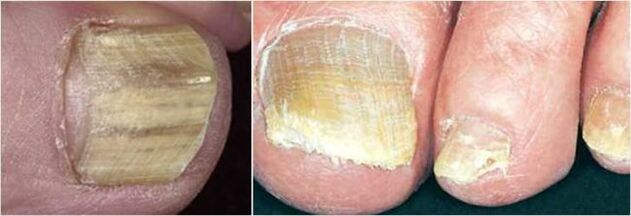
If the toenail fungus is in an advanced stage, do not despair;just follow these rules:
- Find and remove the cause of the infection.
- Disinfect your shoes regularly or change all pairs completely.Buy shoe sprays with an antifungal effect.
- Update your socks.
- Pass all the necessary tests and follow the treatment regimen prescribed by the dermatologist.
- Follow all dietary restrictions.
Therapy in this phase should be carried out in a comprehensive manner.In addition to local drugs, they include effective drugs that act on the fungus from the inside, and also use traditional medicine.With the latter, you need to be careful and take into account any allergic reactions to one or another component.
Types of forms of mycosis
Foot fungus is divided into several types, which depend on the pathogen.Among these types, it is worth noting:
- Rubromycosis.Symptoms of this type are flaky skin, dry skin, excessive sweating, cracking and breaking of nails.
- Athlete's foot.The fungus destroys the nail, destroying the keratin in it.This type of fungus is very difficult to cure;It is resistant to low temperatures, antiseptics, drying and other manipulations.The fungus can reproduce for a long time.The signs of this form are redness of the skin, severe itching, peeling, and the base of the nail becomes scaly.
- Candidiasis.The disease is caused by several types of fungi.The nail plates on the 3rd and 4th fingers are affected.The initial stage is characterized by mild inflammation.After that, swelling occurs, a change in shape and thickness leads to the fact that the cuticle begins to fall off.After such processes, the fungus enters the bed itself and spreads over the entire area of the nail.In this case, the development of onycholysis begins.
Disease prevention

Doctors and scientists say that there are about one and a half million types of mushrooms in the world.Only half of them have been studied, and the choice of treatment for them is quite complicated.The ideal solution is only laser therapy, which will have a beneficial effect on any type of fungus.
To prevent infection with this unpleasant disease, it is important to follow the rules of prevention.Measures to prevent pathology are quite difficult, but do not require financial costs.There are 2 main ways to protect yourself from athlete's foot:
- maintenance of personal hygiene and caution in public places;
- prevention with the help of special drugs.
If you like to visit common places like the bathroom, sauna or swimming pool, be sure to wash your feet well when you get home.Additionally, dry your feet, because the fungus is very tenacious and especially likes a moist environment.Buy socks made of cotton fabric only.This material absorbs moisture well, which is released when the feet start to sweat.When your feet sweat a lot in closed shoes, air them occasionally if possible.
If you go to the store to buy shoes, bring your shoes or socks from home;you should not try on shoes barefoot or use public footwear.Get regular foot care such as pedicures and other treatments.Do not use shared hygiene items.You must have your own foot towel.Well, if someone in your house has contracted athlete's foot, avoid contact with them by all means and provide the patient with separate household items.